Code Analysis Automation for Architecture and Structural Disciplines
Four distinct automation workflows help engineers manage compliance, conflicts.
Code analysis automation for architecture and structural disciplines now consists of executable workflows. Its value depends on understanding what compliance checking, drawing conflict detection, code interpretation, and RFI generation each cover, how they connect, and where licensed review remains essential.
Why code compliance checking has historically consumed so much engineering time in architecture and structural work
Code compliance has long meant that engineers must cross-reference drawing sets against the codes that apply by hand. That work spans disconnected document packages and often happens late, when design decisions are already carried through multiple sheets. The reviewer must find the relevant requirement, locate the design information, and check the design information against the requirement. Each step demands attention, while the volume of material makes omissions difficult to avoid.
Coordination adds to that work because structural, architectural, and MEP packages each have their own standards. Missing callouts, connection-detail gaps, and dimension discrepancies can occur between packages even when no clear error appears within one discipline. A structural detail may look complete in isolation while leaving an unresolved question in the architectural set. Such conflicts are often caught during formal review or in the field, where correction brings rework, RFIs, and schedule slippage. To catch these conflicts earlier, engineers must keep checking the full drawing set closely, which is hard to do quickly by hand.
What code analysis automation actually covers — the four executable workflows
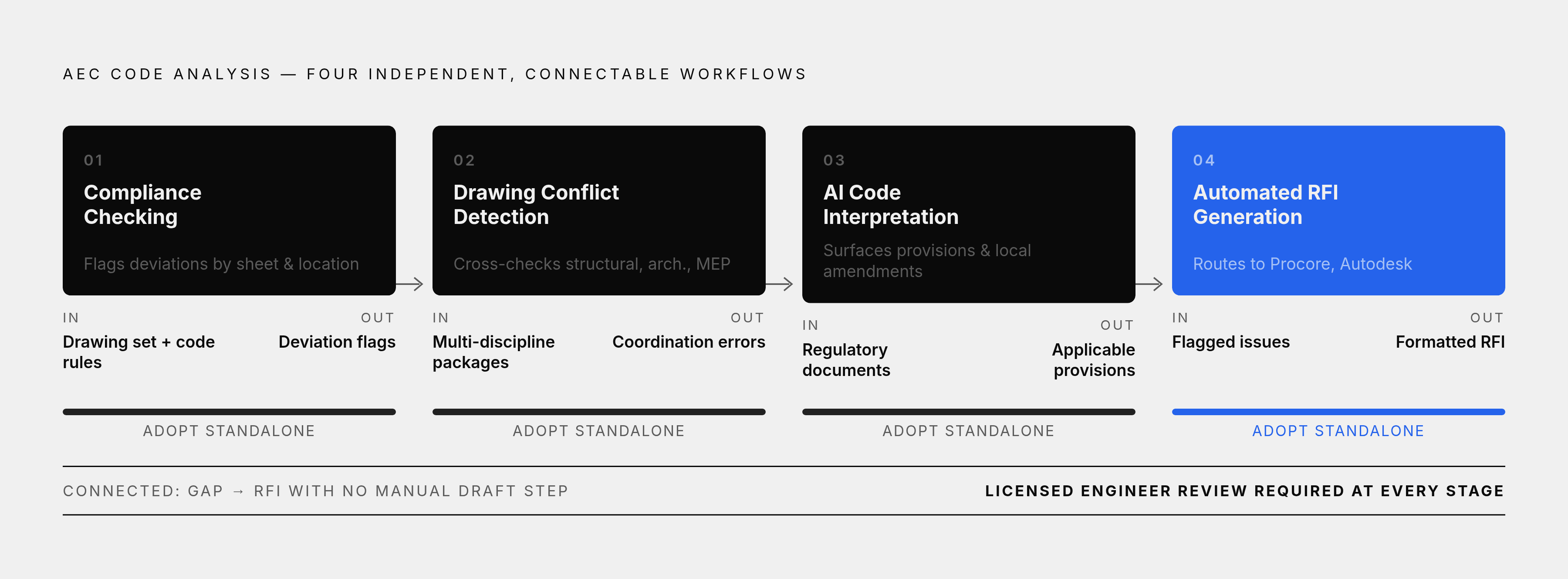
The automation landscape separates into four workflows, namely compliance checking against applicable codes, drawing conflict and coordination error detection, AI-assisted code interpretation, and automated RFI generation. Compliance checking compares design information with codified requirements. Conflict detection checks how information in one drawing package matches another, while code interpretation helps engineers find and understand the provision that applies. RFI generation converts an identified issue into structured project communication. These are distinct tasks with different inputs and different endpoints.
That separation matters because a firm can adopt one workflow without implementing the others. A coordination review does not have to depend on automated code research, and code research does not require an automated RFI process. Gradon, a Y Combinator-backed desktop application for small and mid-size AEC firms, runs these kinds of engineering workflows end-to-end inside the tools a firm already uses. When connected, however, the workflows reduce handoffs because a gap found in the drawing set can move directly into an RFI. Articulate brings drawing analysis, preconstruction code compliance auditing, early clash detection, and automatic RFI generation together in a tool built for construction and solar contractors. The useful distinction is not how broadly a product invokes AI, but which of these tasks it executes.
How compliance checking works against code — what the system reads, what it flags, and what it cannot decide
Automated compliance checking parses 2D drawing sets or BIM data against codified rules. It flags deviations at the sheet and location level, directing the reviewer to the design information that needs attention. The executable task is pattern matching and rule application. This allows the system to check the set as a whole without the engineer having to find every possible discrepancy by hand. It also allows compliance checking to move from a reactive review gate to earlier in design.
A deviation may be an error, a deliberate design choice, or a jurisdictional exception, and a licensed engineer must decide which it is in the context of the design. The practical gain is scope and speed, since automated checking can examine a full set systematically while a human reviewer might audit only a fraction of it. Checking more of the set can bring issues to light before formal plan check or field observation, while the same engineer still decides how much they matter.
How drawing conflict detection finds coordination errors across structural, architectural, and MEP packages
Instead of asking whether a design follows a rule, it asks whether the discipline packages agree and contain the information they reference. Examples include structural connection details that are missing from the architectural set, MEP routing that conflicts with structural members, and callouts that point to details missing from the drawing set. These are coordination failures even before their code implications are considered. Reading across the packages exposes relationships that a reviewer working within one discipline can miss.
Firmus analyzes PDFs of 2D construction drawings during preconstruction through its AI-REVIEW and AI-MATCH tools. Its scope includes design risks, missing information, scope gaps, inconsistencies, and errors. Working from 2D PDFs makes this workflow accessible without requiring a fully coordinated BIM model. The central capability is cross-package scrutiny of the documents firms already produce, rather than scrutiny confined to one model or discipline. Systems that analyze patterns in past project documentation and correspondence can also flag where clashes and constructability conflicts are likely to emerge, extending current-set review into predictive risk flagging.
How AI handles code interpretation — querying building codes and translating requirements into design guidance
Code interpretation begins before there is a rule ready to apply to a drawing. Building codes are long, cross-referential documents written in regulatory language, and the applicable provision may need to be read together with local amendments. Finding and reconciling those requirements is a research task in its own right. Large language models can help surface the relevant requirement and suggest how it applies to a stated design condition. Their distinct contribution here is faster access to the right section of the right document.
The University of Miami research published April 2026 documents prior applications of LLMs to building code interpretation and the applicability of multi-agent architectures to regulatory document reasoning. That establishes a connection between language-based research and computational engineering. A suggested interpretation still needs to be checked for the jurisdiction, project type, and specific design condition. The licensed engineer remains responsible for deciding whether the surfaced requirement actually governs the design.
How automated RFI generation connects conflict detection to project communication
Once an issue has been identified, it must enter the project's communication process. Automated RFI generation converts a coordination conflict, missing detail, or code ambiguity into a formatted, routed request without a separate manual drafting step. Compliance flags and unresolved interpretation questions can therefore follow the same downstream path as drawing conflicts. The workflow then records and assigns the issue, though resolving it still requires technical review.
Articulate automatically generates RFIs from its drawing analysis workflow and integrates with platforms including Procore and Autodesk. That connection places the output in the project management system where the team already works. By contrast, an RFI contained only in a separate analysis report still requires someone to translate, reformat, and enter it. The distinction is operational, because identifying a problem and placing a request in the project workflow are different steps. Automatic routing completes the documentation chain, but it does not make the underlying question settled or the generated wording ready to act on without review.
What LLM-based structural analysis automation adds for the structural discipline specifically
LLM-driven workflows can read a problem written in natural language, build a finite element model, run analysis across platforms, and return results. This addresses the repeated setup required when a specialist manually enters the same model parameters into separate FEA tools.
The University of Miami research published April 2026 developed a two-stage multi-agent LLM architecture for frame structural analysis across ETABS, SAP2000, and OpenSees. The first stage extracts geometric, material, boundary, and load parameters from user input into a unified JSON representation. The second translates that representation into executable scripts for each platform in parallel. When tested on twenty representative frame problems, the system had accuracy above ninety percent across all cases in repeated trials. That result applies only to the tested frame problems.
The architecture uses one problem representation across multiple analysis platforms so the same parameters need to be entered only once. It returns results for engineer review rather than transferring responsibility for the model to the language model. Other approaches use the Model-Context-Protocol (MCP) framework to help agents understand the design context and work with expert software tools.
Where human review is not optional — what licensed engineers must do regardless of how much automation is in the workflow
Across the four document workflows, automation surfaces and formats issues but does not resolve them or carry legal accountability for its outputs. A licensed engineer must review an output before anyone acts on it. For compliance and interpretation, that means deciding whether a requirement applies and whether the design satisfies it. For conflict detection and RFI generation, it means assessing the issue and the communication produced from it. The review is part of the workflow's design from the outset.
Structural analysis makes the reason especially clear because an undetected error can have consequences for both safety and documentation. The reported research accuracy does not remove the need to scrutinize model inputs and analysis results. Strong results on representative frame problems also leave open how well the system will work for every structural condition. The engineer must retain judgment over the computational work just as over drawing-level findings.
How firms connect these workflows to their existing tools rather than replacing them
Implementation depends on whether automation fits the firm's existing formats and software. A workflow that reads 2D PDFs can use drawing sets the firm already produces, and a direct link to project management tools keeps reporting in the same place. Articulate's RFI integrations and Firmus's dashboards and collaboration tools for issues across design iterations illustrate different ways to manage detected issues. Finding issues quickly across more of the set brings less benefit if someone must then rebuild the output by hand elsewhere.
The same principle applies to structural analysis, where a unified JSON intermediate can feed platform-specific scripts instead of requiring a firm to standardize on one FEA tool. At the broader software layer, MCP enables agents to operate existing expert tools. It uses that preparation to align compliance checking, conflict detection, and RFI generation with firm practice, with every AI output reviewed and stamped by a licensed professional.
What a realistic adoption path looks like for a small or mid-size architecture or structural firm
A practical adoption path starts with the workflow consuming the most measurable engineering time. That may be plan check preparation, coordination review, or RFI drafting, and firms often start with drawing conflict detection and compliance checking. Before the pilot begins, the firm should make sure the workflow works with its document formats and project platforms. Otherwise, changes to the workflow can make the test hard enough to run that it stalls before the firm can measure the results. Starting with one task keeps the evaluation tied to a defined problem rather than an attempt to deploy all four workflows at once.
The next step is a pilot on a real project, with a licensed engineer reviewing all outputs. The firm can then measure the difference in hours and error rate before deciding whether to extend into adjacent workflows. Direct support that works with engineers, rather than a software handover followed by self-directed adoption, helps connect the tool to established practice. Expansion should follow the measured result. These workflows are executable now, and firms can adopt them with confidence when they understand the task being automated, the tools it must fit, and the decisions that remain with licensed professionals.