AI for MEP Calculations in Building Design
AI can now run rule-bound MEP calculations, but judgment calls still require the engineer.
AI is now capable of executing specific, well-defined MEP calculation workflows, from load and pipe sizing to clash detection. This piece maps exactly where those capabilities land in a real design process, what the evidence actually supports, and where the licensed engineer of record still governs.
What MEP calculations actually involve and why they are hard to automate
MEP calculation work divides into three discipline-specific families: mechanical, covering HVAC load sizing, duct sizing, and ventilation. Electrical, covering load analysis, cable sizing, and distribution board schedules. And plumbing, covering pipe sizing, hydraulic calculations, and flow rates. Each family has its own standards, its own interdependencies, and its own failure modes. What goes wrong in a duct sizing calc does not resemble what goes wrong in a cable schedule, and the tools that serve one discipline rarely transfer cleanly to another. This is the first structural reason the work resists blanket automation.
The stakes are not small. MEP systems typically account for a third to half of total commercial construction cost. A calculation error is therefore not a documentation problem. It becomes a budget problem the moment quantities are extracted, and a safety problem the moment fabricated components reach the site. The reason automation matters here is not convenience. It is that errors in this work propagate into procurement and installation in ways that are expensive to reverse.
The calculations themselves are not monolithic. Some steps are well-defined and rule-bound. Applying ASHRAE/ACCA Standard 183 load formulas to a given zone is deterministic once the inputs are specified. Other steps require contextual judgment: deciding how to treat an unusual building geometry, or how to handle a code exception, is not something a formula resolves. This split is the key to understanding what AI can and cannot do. It is also why partial automation is both possible and bounded. The rule-bound steps are automatable because they are, in a precise sense, procedures. The judgment steps are not.
Coordination across disciplines multiplies the complexity beyond what any single-discipline calculation captures. MEP routing has to avoid structural clashes, equipment placement has to satisfy architectural and mechanical constraints at once, and if one system changes, it can ripple through three others. That spatial, multi-system problem is a separate category of work from sizing a duct or a pipe, and it requires a separate category of tool.
Where AI is capable of executing MEP calculation work today
AI systems can now execute the rule-bound, multi-step calculation workflows in MEP design where the inputs are defined and the governing standard is deterministic. Load sizing across zones, duct and pipe sizing, distribution board scheduling, and hydraulic calculations all work this way. The capability is real, and it is productized. The question is no longer whether AI can run these calculations, but how completely it can carry them through to a finished deliverable.
The operational pattern that separates current systems from earlier AI assistants is context. These are not single-question tools that accept a prompting dialogue and return a number. They are systems that hold full project context: building type, floor count, room schedule, applicable codes. From that context they run a connected sequence: interpret the layout, apply the load formula per the governing standard, size the equipment, generate the schedule, produce the coordinated drawing, and extract quantities. The human does not re-enter data at each step, which is where the practical time savings actually come from.
On the electrical side, the shift is already visible in the product landscape. Agentic platforms are completing lighting load calculations per IS/IEC standards, cable sizing, circuit diagrams, and BOQ extraction as one triggered workflow rather than a series of manual handoffs. The distinction between answering a sizing question and completing the electrical design package is now a real product difference. It is not a marketing claim. The workflow exists and can be triggered end to end.
The HVAC picture is more studied than deployed, but the evidence is substantial. A critical review of LLMs in building energy systems maps applications across fault detection and diagnostics, forecasting, building energy modeling, control, and occupant comfort. Building energy modeling, designated as the A3 application category, has the largest evidence base. The strongest results come when LLMs are grounded with retrieval, tools, and agentic workflows, a combination the review labels the M2 method family. The finding is specific: grounding and orchestration matter more than raw language capability.
On the hydraulic side, the integration story is already built. Tools like CALHYDRA connect directly to BIM authoring environments, so you can transfer water, heating, and cooling pipe system data for hydraulic calculations. Results are written back into the model. The calculation and the model stay in sync rather than diverging across manual export steps. This is a meaningful difference in a discipline where the gap between calculated pipe size and modeled pipe size has historically been a source of silent error.
How the evidence base for AI in HVAC and energy modeling actually looks
The research evidence behind AI in MEP calculations is real but uneven. Simulation studies dominate the literature. Retrospective field studies form a significant secondary tier. Pilot deployments in live building environments remain rare. This is not a reason to dismiss the capability, but it is a reason to be precise about what the evidence supports and what it does not.
The critical review of LLMs in HVAC operations categorizes 66 primary papers by application and method. The largest concentration of work sits at the intersection of building energy modeling and grounded or agentic LLM methods. Yet most of that evidence comes from simulation or retrospective field data, not from live operational deployments. A system that performs well in a simulation study using clean, labeled BAS point data is making a different claim than one that performs well in a live firm with a legacy BAS, inconsistent point naming, and fragmented equipment manuals. The latter is the actual condition most MEP engineers work in.
The fragmentation problem is structural rather than incidental. BAS point names, equipment metadata, and O&M manuals are scattered across portfolios and rarely travel cleanly between project phases. The semantic gap between what the AI needs to read and what the firm actually has is a genuine deployment constraint. It is not a limitation of the algorithms. It is a limitation of the data environment those algorithms must operate in, and it is one of the primary reasons pilot deployments remain rare while simulation studies proliferate.
What clash detection and coordination AI does that calculation AI cannot do alone
Clash detection and routing coordination are a distinct category of AI value. No single-discipline calculation tool can capture it, because the problem is spatial and multi-system. MEP paths must negotiate structure, architecture, and other services simultaneously. A duct sized correctly by a load calculation can still be routed into a beam at coordination time, and that failure belongs to a different workflow entirely.
Automated routing and coordination platforms operate by reading BIM geometry, identifying conflict zones, and generating clash-free routing paths. Augmenta's Construction Platform is one active example, with recent enhancements to automated routing and coordination for electrical systems in BIM environments. The scope is worth stating precisely: the documented capability covers electrical systems, not full MEP routing across all three disciplines. What such tools offer is not isolated duct sizing but a spatial solution that no calculation engine produces.
The cost of failure concentrates in this part of the process. Late-stage clash discovery after installation has begun is one of the primary drivers of construction rework. Rework costs construction projects an estimated $625 billion per year globally. If you catch clashes in the model before fabrication, AI coordination tools are worth adopting even when the underlying calculations were done manually. The economic case stands independent of the calculation case.
BIM-native MEP environments push the same logic further. MEP Designer, built on the Archicad core engine and currently available in select European and Asian markets with ongoing global expansion, aims to close the loop between calculation inputs, model geometry, and documentation. The goal is that a change in one does not create undetected discrepancies in the others. That closure is what turns a set of capable tools into a coherent design environment.
Where licensed engineer judgment still governs and AI hands work back
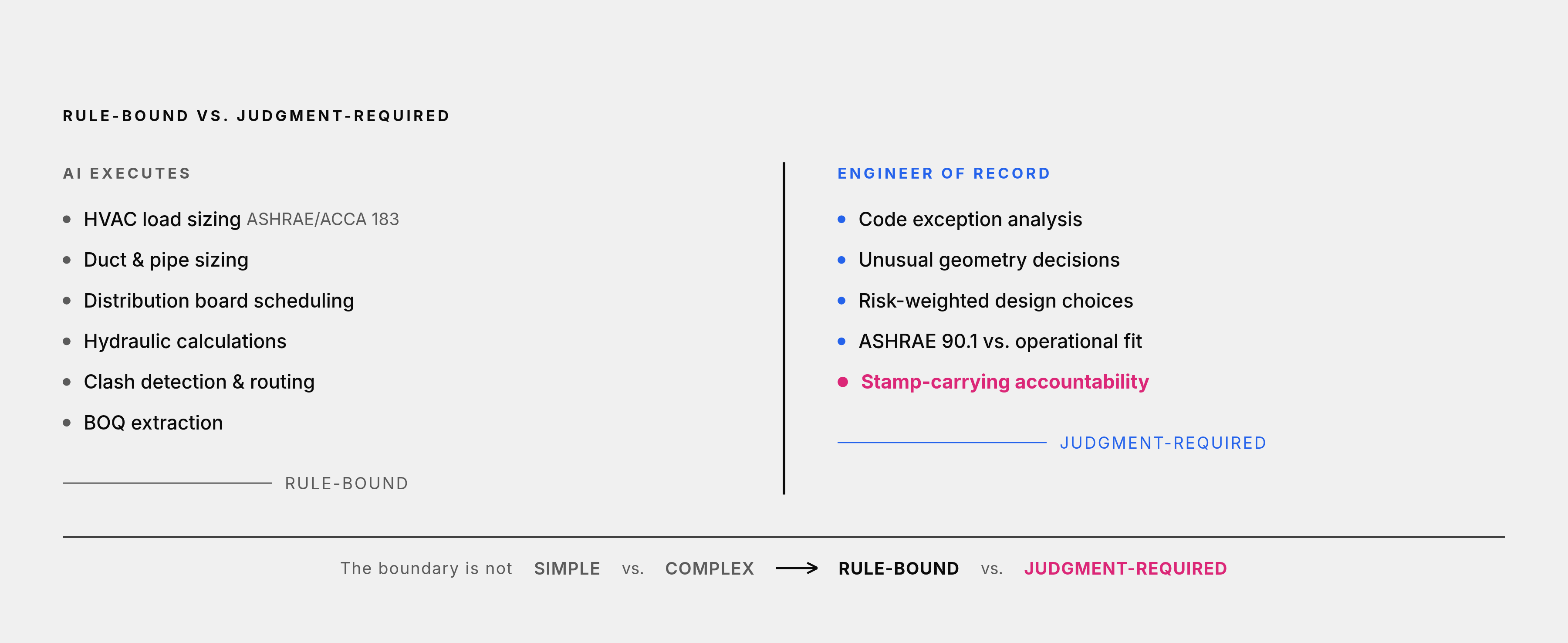
AI handles the rule-bound, input-defined steps of MEP calculation. It does not govern the decisions that require contextual engineering judgment: code exception analysis, unusual geometry, risk-weighted design choices, and stamp-carrying accountability. Every tool in active deployment today has mandatory engineer review built into the workflow. It is not a disclaimer appended to the output. It is the structural position of the human in the system.
The boundary is functional rather than philosophical. An AI system that runs HVAC load calculations across every zone and generates the sizing schedule is doing work an engineer would otherwise do. That is precisely what makes it useful. The same system cannot decide whether a design that technically passes ASHRAE 90.1 is the right design for a client's operational profile, occupancy pattern, or future-use scenario. That judgment requires knowledge of the client, not knowledge of the standard.
The evidence bears out this boundary. Fault detection and diagnostics, the A1 application in the LLM-in-HVAC review, shows a thinner evidence base than energy modeling: 9 primary papers across all method families versus 32 for building energy modeling. AI's ability to interpret anomalous operational behavior in live systems is less mature than its ability to model and size systems at design time. The capability map is not uniform. It is strongest at the front end, weaker in live operations, and this pattern aligns with where the judgment requirements are lowest.
Licensed professional review is not optional overhead on top of AI output. In any jurisdiction where MEP engineers carry a seal, the engineer of record's judgment and liability attach to every deliverable. Human review is a structural feature of the workflow, not a quality-control add-on that a firm might choose to skip for speed. The stamp is the point of the profession, and AI has not displaced it.
How MEP calculation AI fits into a firm's existing tools and workflows
The tools gaining traction in MEP practices are not standalone AI systems that require firms to leave their existing platforms. They are integrations that plug into the environments engineers already work in: BIM authoring tools, hydraulic calculation software, routing coordination platforms, and project documentation systems. The pattern is consistent across the current product landscape, and it reflects a practical reality. A firm's project data, standards, and deliverables live in specific tools, and an AI that cannot operate there is an AI the firm will not adopt.
CALHYDRA's direct connection to MEP Designer is one concrete example of this pattern. Hydraulic calculation results update the BIM model through a dedicated interface, so the calculation and the model stay synchronized without a manual export-import loop. The AI fits the workflow rather than the other way around. This is the integration model that the rest of the market is converging on.
Gradon follows the same logic for AEC firms more broadly. It delivers MEP calculations and coordination work inside Revit and the tools you already use. It learns the firm's own past projects and standards so its output matches the firm's format. Finished work stays in the firm's own project folders, and the system never trains on client data, though the Firm Brain is stored in Gradon's cloud. The model fits the firm, which is the actual differentiator that determines whether a tool gets used past the pilot phase. Gradon is one concrete example of the category pattern, not the only option.
If you are evaluating AI for MEP work, check three practical factors before you pick a tool. First, whether it integrates with the BIM and calculation platforms the team already uses. Second, whether its output format matches the firm's deliverable standards, or can be trained to. Third, whether the data handling model is compatible with client confidentiality obligations. These three questions screen out most of the mismatch risk before a purchase is made.
What to expect from AI in MEP calculations over the next design cycle
If you read the signals from 2026 investment and product activity, discipline-specific AI is maturing faster than general-purpose AI in MEP. Tools built for a specific calculation family, governed by a specific standard, in a specific software environment are outperforming broad-purpose AI assistants on actual engineering tasks. The direction is clear and documented. The uncertainty lies in how quickly it extends across all three disciplines.
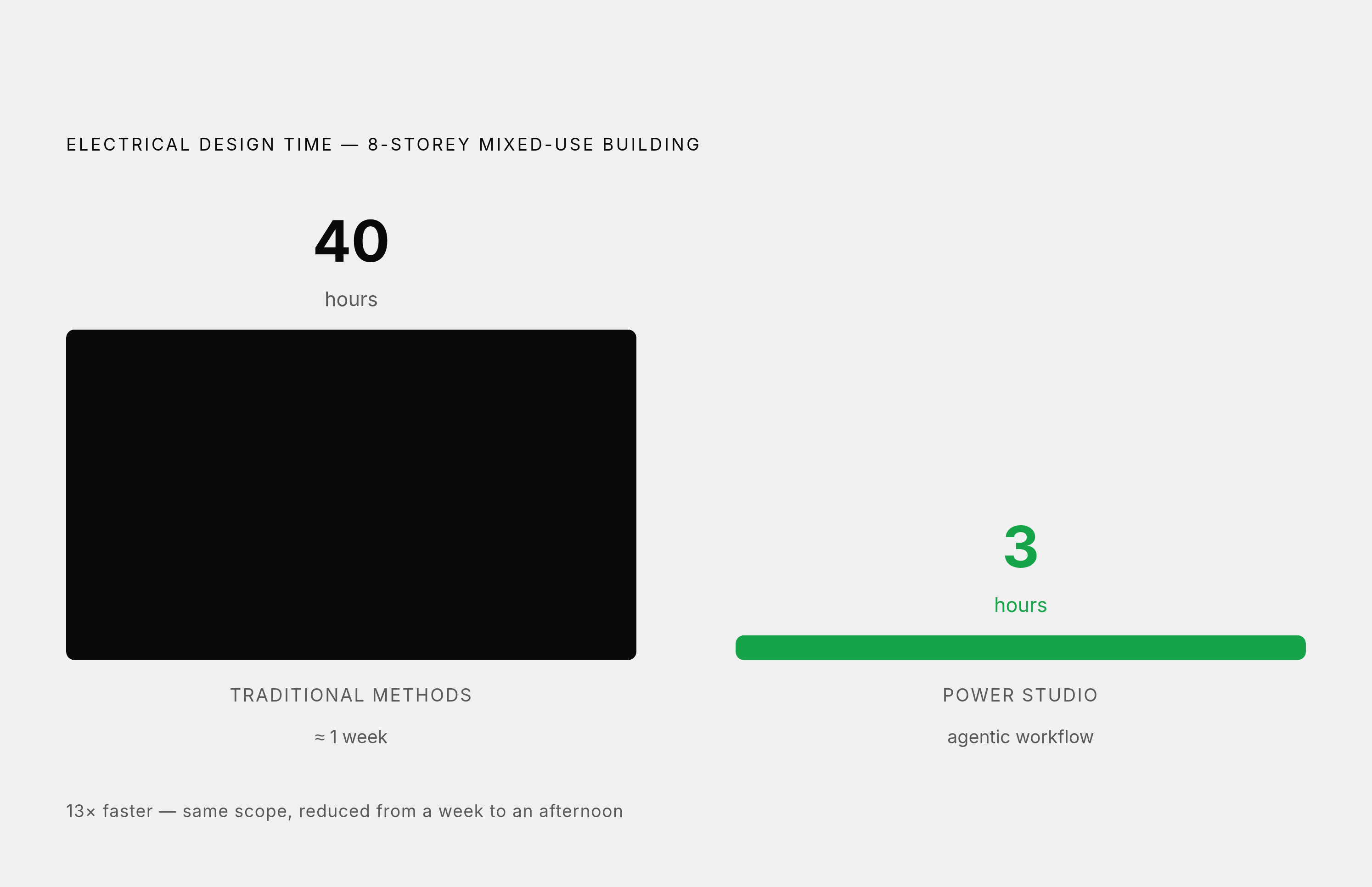
Electrical design platforms show the most dramatic compression. Endra's Power Studio, demonstrated on an eight-storey mixed-use building, cuts a week of electrical design work to about three hours. HVAC acoustic design automation is following a similar pattern: calculation steps that previously took days are now reduced to automated runs. The headline numbers are specific to well-defined building types, but the trajectory they indicate is broader. Where the inputs are clean and the standard is deterministic, the time collapse is real.
Firms should calibrate their expectations around where the evidence is strong. The evidence base for AI in live HVAC operations, meaning fault detection and real-time control, is thinner than for design-time modeling and sizing. Near-term productivity gains are therefore concentrated at the front end of the design process rather than in building operations. A firm deciding where to invest should weight that asymmetry accordingly.
The workforce pressure driving adoption is structural and not going away. A retiring senior workforce, rising project complexity, and flat or shrinking team sizes leave you with one simple question. The question for most MEP firms is not whether to adopt AI-assisted calculation tools but which ones fit their discipline mix and their existing software environment. That is a selection problem, not a discovery problem, and the firms that treat it as such will move faster than the ones still waiting for a general solution.